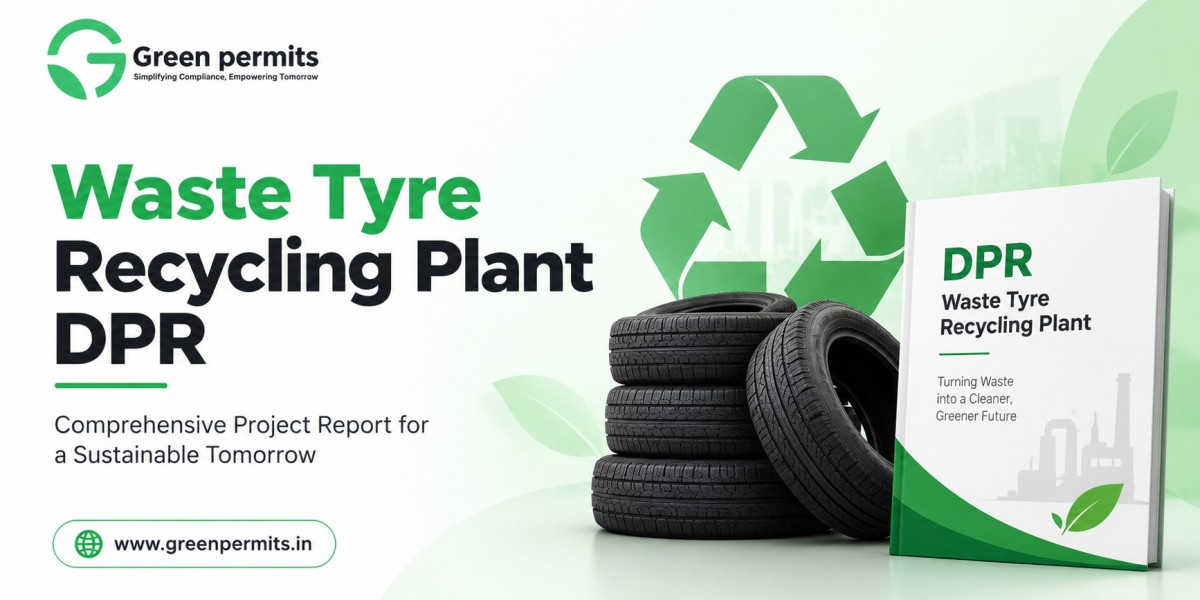

A Waste Tyre Recycling Plant DPR is a Detailed Project Report prepared before investing in a tyre recycling facility to evaluate the project's technical feasibility, machinery requirement, feedstock availability, land requirement, environmental approvals, investment, operating cost, revenue potential, working capital, and expected profitability.
Waste tyres can be processed into products such as crumb rubber, rubber granules, rubber powder, recovered steel, reclaimed rubber, and other recycled outputs, depending on the technology selected.
For an investor, the biggest mistake is purchasing machinery first and studying feedstock, approvals, product demand, and plant economics later. A properly prepared DPR reverses this process.
The recommended approach is:
Feedstock Study → Product Selection → Capacity → Technology → Machinery → Site → Approvals → CAPEX → OPEX → Revenue → Profitability → Implementation
Green Permits Consulting helps entrepreneurs and recycling companies prepare complete Waste Tyre Recycling Plant DPRs along with plant layout, pollution-control planning, CPCB/SPCB compliance, and project setup support.
What is a Waste Tyre Recycling Plant?
A waste tyre recycling plant processes used or discarded tyres to recover usable secondary raw materials.
Depending on the technology, the plant may convert waste tyres into:
- Crumb rubber
- Rubber granules
- Rubber powder
- Reclaimed rubber
- Recovered steel wire
- Textile fibre
- Other recyclable fractions
The right recycling route depends on:
- Type of waste tyre
- Desired final product
- Local market
- Plant capacity
- Investment budget
- Environmental compliance
- Technology availability
A DPR helps identify which business model is most suitable before investment.
Why Prepare a DPR Before Setting Up a Waste Tyre Recycling Plant?
A recycling plant can look profitable on machinery brochures but still fail commercially if the feedstock, selling price, capacity utilisation, energy cost, or working capital assumptions are unrealistic.
A DPR helps answer questions such as:
- How many tonnes of waste tyres are available?
- What capacity should the plant have?
- Should the project produce crumb rubber or rubber powder?
- How much land is required?
- Which machinery is required?
- How much electricity will the plant consume?
- What pollution-control systems are needed?
- Which approvals are required?
- What will be the project cost?
- How much working capital will be required?
- What will be the expected monthly revenue?
- When can the project reach break-even?
These questions should be answered before machinery is ordered.
What Does a Waste Tyre Recycling Plant DPR Include?
A professional DPR generally includes:
- Executive summary
- Promoter profile
- Project concept
- Market assessment
- Waste tyre availability
- Feedstock sourcing plan
- Product selection
- Plant capacity
- Process technology
- Machinery requirement
- Plant layout
- Land requirement
- Utility requirement
- Manpower
- Environmental compliance
- Pollution-control systems
- Regulatory approvals
- CAPEX
- OPEX
- Working capital
- Revenue projections
- Profitability
- Break-even analysis
- Cash flow
- DSCR, where required
- Risk analysis
- Implementation schedule
For bank or investor funding, the financial section should be supported by realistic assumptions.
Waste Tyre Recycling Business Models
There is no single tyre recycling model.
A DPR should first determine what the plant will actually manufacture.
1. Crumb Rubber Plant
Waste tyres are mechanically processed into smaller rubber particles.
A typical process is:
Waste Tyres → De-beading → Cutting → Shredding → Granulation → Steel Separation → Fibre Separation → Crumb Rubber
Crumb rubber can be used in various rubber and industrial applications depending on quality and particle size.
2. Rubber Powder Plant
Rubber crumb can be further processed into finer powder.
A simplified process is:
Waste Tyre → Shredding → Granulation → Fine Grinding → Rubber Powder
Finer material generally requires additional grinding and separation equipment.
3. Reclaimed Rubber Plant
Waste tyre rubber can be processed using specialised technology to produce reclaimed rubber for suitable industrial applications.
This type of project requires a different manufacturing process, machinery configuration, utility requirement, and pollution-control system compared with a simple mechanical crumb rubber plant.
4. Integrated Tyre Recycling Facility
A larger plant may combine multiple activities such as:
- Tyre collection
- Shredding
- Crumb production
- Rubber powder
- Steel recovery
- Fibre separation
- Other downstream processing
The DPR should clearly define each output stream.
Waste Tyre Feedstock Assessment
The commercial success of the project depends heavily on reliable waste tyre supply.
Potential sources can include:
- Tyre dealers
- Transport companies
- Fleet operators
- Truck operators
- Bus operators
- Automobile workshops
- Scrap aggregators
- Tyre replacement centres
- Automobile companies
- Waste collection networks
The DPR should estimate:
Available Waste Tyres per Month → Purchase Cost → Transportation Cost → Plant Requirement
Without reliable feedstock, installed machinery may remain underutilised.
Why Feedstock Location Matters
Waste tyres are bulky.
Transportation can therefore become a significant cost.
Suppose a plant consumes 20 tonnes per day and operates 25 days per month.
Monthly feedstock requirement would be:
20 TPD × 25 Days = 500 Tonnes per Month
If tyres must be transported over long distances, logistics cost can materially reduce profitability.
For this reason, the site should ideally be located close to:
- Waste tyre sources
- Transport corridors
- Industrial areas
- Product buyers
Selecting the Right Plant Capacity
Capacity should be selected according to actual waste availability rather than the largest machine the investor can afford.
Broad commercial planning categories may include:
Small Plant
2 to 5 TPD
Medium Plant
10 to 20 TPD
Large Plant
25 TPD and above
These are indicative business planning ranges and not regulatory classifications.
A 20 TPD machine does not guarantee 20 TPD of production if only 8 TPD of tyres can be procured reliably.
Example Capacity Calculation
Consider a proposed capacity of:
10 TPD
If the plant operates for 300 days:
10 × 300 = 3,000 tonnes per year
At 80% practical capacity utilisation:
3,000 × 80% = 2,400 tonnes per year
Financial modelling should generally use realistic capacity utilisation rather than assuming maximum output from Day 1.
Waste Tyre Recycling Process
For a mechanical recycling plant, the process can broadly be:
Waste Tyre Reception
↓
Inspection and Sorting
↓
De-beading
↓
Tyre Cutting
↓
Primary Shredding
↓
Secondary Shredding
↓
Granulation
↓
Magnetic Steel Separation
↓
Fibre Separation
↓
Crumb / Granule Classification
↓
Packing and Dispatch
The exact sequence depends on plant design.
Machinery Required for Waste Tyre Recycling Plant
A mechanical tyre recycling facility may require:
- Tyre de-beader
- Sidewall cutter
- Tyre shredder
- Primary shredder
- Secondary shredder
- Granulator
- Rubber cracker mill
- Magnetic separator
- Fibre separator
- Vibrating screen
- Conveyor system
- Dust collection system
- Storage system
- Weighing equipment
- Packing equipment
For fine rubber powder production, additional grinding equipment may be required.
Machinery Selection in a DPR
Machinery selection should consider:
- Feed size
- Final particle size
- Plant capacity
- Motor load
- Automation
- Recovery rate
- Spare parts
- Maintenance
- Supplier support
- Energy consumption
The cheapest machine is not always the lowest-cost machine to operate.
A DPR should compare CAPEX and operating efficiency together.
Expected Material Recovery
A tyre contains multiple recoverable fractions.
These can include:
- Rubber
- Steel
- Textile fibre
The exact recovery percentage varies according to tyre type, feedstock composition, machinery, and processing method.
The DPR should therefore prepare a realistic material balance rather than using one universal recovery figure.
For example:
1,000 kg Waste Tyres
may be separated into:
- Recovered rubber
- Steel
- Fibre
- Process loss
The exact percentages should be based on the project's actual feedstock and technology.
Why Material Balance Matters
Material balance affects both compliance and profitability.
If a plant receives:
300 tonnes of waste tyres
the DPR should explain where those 300 tonnes ultimately go.
For example:
Input = Rubber Output + Steel + Fibre + Rejects + Process Loss
This helps estimate:
- Product revenue
- Waste generation
- Storage
- Pollution-control requirement
- Regulatory reporting
A material balance is particularly important for EPR-related recycling records.
Land Requirement for Waste Tyre Recycling Plant
Land requirement depends on:
- Capacity
- Machinery
- Waste tyre storage
- Finished-product storage
- Fire safety
- Internal vehicle movement
- Pollution-control systems
- Future expansion
A plant may require separate areas for:
- Incoming tyres
- Sorting
- De-beading
- Shredding
- Granulation
- Finished crumb rubber
- Steel storage
- Fibre storage
- Reject material
- Utilities
- Administration
- Fire safety systems
Large volumes of tyres require substantial storage space.
Plant Layout for Waste Tyre Recycling
A practical material flow can be:
Entry / Weighbridge
↓
Waste Tyre Storage
↓
Sorting
↓
De-beading and Cutting
↓
Shredding
↓
Granulation
↓
Steel and Fibre Separation
↓
Rubber Classification
↓
Finished Product Storage
↓
Dispatch
The layout should minimise unnecessary material movement.
Fire Safety Planning
Waste tyre storage creates a significant fire load.
Fire planning should therefore be incorporated into the project from the beginning.
Depending on the facility, requirements may include:
- Fire extinguishers
- Hydrant system
- Fire-water storage
- Emergency exits
- Fire access road
- Storage segregation
- Electrical safety
- Emergency response plan
Large tyre piles should be managed carefully.
Fire compliance should be reviewed according to the actual project and local requirements.
Pollution Control for Tyre Recycling Plant
Mechanical tyre recycling can generate:
- Rubber dust
- Fine particles
- Noise
- Fibre
- Waste
- Fugitive emissions
Environmental controls can include:
- Dust extraction
- Bag filters
- Enclosed machinery
- Local exhaust ventilation
- Proper flooring
- Noise-control arrangements
- Waste storage systems
The pollution-control configuration should match the actual technology.
Water Requirement
A purely mechanical dry tyre recycling plant may have limited industrial water consumption compared with many wet-process industries.
Water may still be required for:
- Domestic use
- Cleaning
- Fire systems
- Other utilities
If the process involves washing or another water-based operation, wastewater treatment requirements should be evaluated separately.
Electricity Requirement
Tyre shredders and granulators can require substantial electrical power.
The DPR should calculate the connected load of:
- Shredder
- Granulator
- Cracker mill
- Conveyor
- Separator
- Dust collector
- Compressor
- Other utilities
Electricity cost should be included in the cost per tonne.
Manpower Requirement
Manpower can include:
- Plant manager
- Machine operators
- Helpers
- Sorting staff
- Maintenance staff
- Electrician
- Store personnel
- Accounts
- Compliance staff
- Security
The number of employees depends on automation and plant capacity.
Regulatory Approvals for Waste Tyre Recycling Plant
A waste tyre recycling facility may need to assess multiple approvals.
Depending on the project, these can include:
- Consent to Establish from the concerned SPCB/PCC
- Consent to Operate
- Waste Tyre Recycler Registration under the applicable CPCB EPR framework
- Hazardous Waste Authorisation, where applicable
- Factory-related approvals
- Fire approval
- Local approvals
- Electricity connection
- GST and business registrations
- Other project-specific permissions
The exact approval matrix should be prepared according to the process, state, and capacity.
CPCB Waste Tyre EPR Recycler Registration
India has an Extended Producer Responsibility framework for waste tyres.
Eligible recyclers participating in the formal system need to assess the applicable CPCB registration and EPR portal requirements.
The recycler may need to maintain records relating to:
- Waste tyres received
- Source
- Quantity
- Recycling activity
- Recycled output
- Capacity
- EPR certificates, where eligible
- Certificate transactions
- Closing stock
The capacity reflected in CPCB and Pollution Control Board approvals should remain consistent with actual operations.
EPR Certificate Opportunity for Waste Tyre Recyclers
Formal recyclers may participate in the applicable Waste Tyre EPR certificate mechanism based on eligible recycling activity.
This can create an additional revenue stream alongside the sale of recovered materials.
A recycler's potential revenue model may therefore include:
Recycled Rubber Revenue + Recovered Steel Revenue + Eligible EPR Certificate Revenue
However, EPR certificates should not be treated as guaranteed revenue independent of actual recycling.
Certificate generation should be backed by genuine processing and regulatory records.
Waste Tyre EPR and Producer Demand
Tyre producers covered by the EPR framework need to fulfil applicable recycling obligations.
This creates demand for eligible recycling certificates generated by registered recyclers.
A DPR may therefore assess:
- Physical recycled product market
- Steel recovery
- EPR certificate potential
But projections should remain conservative because certificate pricing and availability can change.
DPR for Crumb Rubber Plant
A crumb rubber DPR should specifically evaluate:
- Waste tyre sourcing
- Target particle size
- Machinery
- Rubber recovery
- Steel recovery
- Fibre generation
- Electricity
- Labour
- Crumb rubber buyers
- Product pricing
- EPR compliance
- Profitability
Market demand should be established before selecting the final particle-size range.
Crumb Rubber Market
Crumb rubber may be used in suitable applications such as:
- Rubber products
- Moulded products
- Flooring
- Mats
- Sports surfaces
- Industrial applications
- Road-related applications, where specifications permit
- Other rubber-compound applications
The exact market depends heavily on:
- Particle size
- Purity
- Metal contamination
- Fibre contamination
- Consistency
Higher-quality material generally attracts better buyers.
Revenue from Recovered Steel
Steel wire recovered from tyres can provide a secondary revenue stream.
However, actual realisation depends on:
- Steel cleanliness
- Rubber contamination
- Market price
- Buyer
- Quantity
The DPR should separately calculate rubber and steel revenue.
Waste Tyre Recycling Plant CAPEX
CAPEX can include:
- Land
- Site development
- Factory shed
- Machinery
- Electrical installation
- Transformer
- Pollution-control systems
- Fire systems
- Material handling
- Laboratory or testing equipment
- Office infrastructure
- Pre-operative expenses
The total investment can vary significantly depending on technology and scale.
A small mechanical plant may require investment in tens of lakhs of rupees, while larger automated facilities can require several crores when land, civil work, machinery, utilities, and working capital are included.
The DPR should obtain actual quotations before finalising project cost.
Typical DPR CAPEX Structure
The financial section may be divided into:
1. Land and Site Development
Purchase or lease-related project cost.
2. Civil Construction
Factory shed, storage, office, roads and utilities.
3. Plant and Machinery
Complete tyre recycling line.
4. Electrical Infrastructure
Panels, cabling, transformer and connection.
5. Pollution and Safety
Dust control, fire systems and environmental infrastructure.
6. Pre-Operative Expenses
Consultancy, approvals, installation, testing and commissioning.
7. Working Capital Margin
Initial money required to operate the plant.
Waste Tyre Recycling Plant OPEX
Operating expenses can include:
- Waste tyre procurement
- Transport
- Electricity
- Labour
- Maintenance
- Spare parts
- Packaging
- Rent, where applicable
- Compliance
- Insurance
- Administration
- Waste disposal
- Finance cost
For many projects, waste tyre procurement is one of the largest operating expenses.
Working Capital Requirement
Working capital is often underestimated.
Suppose a 10 TPD plant operates 25 days per month.
Monthly input:
10 × 25 = 250 tonnes
If the illustrative average landed cost of waste tyres were ₹18 per kg:
250,000 kg × ₹18 = ₹45,00,000
This means approximately ₹45 lakh could be required for one month of tyre procurement alone in this hypothetical example.
The actual waste tyre price can differ significantly by location, tyre category, condition, and market conditions.
The example demonstrates why working capital should not be ignored.
Waste Tyre Recycling Plant Revenue Calculation
A DPR should calculate revenue product by product.
A simplified formula is:
Rubber Output × Selling Price
Steel Output × Selling Price
Other Eligible Revenue
=
Total Revenue
From this, calculate:
Revenue - Raw Material - Power - Labour - Transport - Maintenance - Other OPEX = Operating Profit
The model should be prepared monthly and annually.
Example of Capacity Utilisation
A DPR should generally assume gradual capacity utilisation.
For example:
Year 1 - 60%
Year 2 - 75%
Year 3 - 85%
rather than assuming 100% from the first year.
These are only illustrative assumptions.
Actual utilisation should be based on the project's commercial situation.
Break-Even Analysis
The break-even point indicates the minimum operating level required to cover fixed and variable costs.
The DPR should calculate:
- Fixed cost
- Variable cost
- Contribution
- Break-even sales
- Break-even capacity
This helps investors understand the minimum volume required to avoid operating losses.
Payback Period
Payback period measures how long the business may take to recover its initial investment from project cash flows.
It depends on:
- CAPEX
- Capacity utilisation
- Feedstock cost
- Selling price
- Product recovery
- Electricity
- Working capital
- EPR-related revenue
Payback should be calculated from project-specific numbers rather than using a standard figure for every tyre recycling plant.
Profitability Sensitivity Analysis
A good DPR should test what happens if assumptions change.
For example:
Scenario 1: Waste Tyre Cost +10%
Scenario 2: Crumb Rubber Price -10%
Scenario 3: Plant Utilisation 60% Instead of 80%
Scenario 4: Electricity Cost +15%
If the project becomes unprofitable after a small change in one assumption, the investor should know this before investing.
Waste Tyre Recycling Plant DPR for Bank Loan
A bankable DPR may need financial statements such as:
- Project cost
- Means of finance
- Projected Profit and Loss
- Cash flow
- Balance sheet
- Working capital assessment
- Break-even
- DSCR
- Loan repayment
- Depreciation
- Interest
- Sensitivity analysis
The final format may depend on the bank or financial institution.
DPR for Investor Funding
An investor-oriented DPR may place greater emphasis on:
- Market size
- Feedstock security
- Competitive advantage
- Product strategy
- Management
- EBITDA
- Scale-up
- EPR certificate opportunity
- Risk
- Return on investment
- Exit potential
Technical and financial information should still remain consistent.
State Pollution Control Board CTE
Before setting up the facility, the investor should assess the requirement for Consent to Establish from the relevant State Pollution Control Board.
The application may include:
- Plant capacity
- Process
- Machinery
- Water requirement
- Air pollution
- Waste generation
- Pollution-control systems
- Land documents
- Plant layout
The DPR and CTE application should use consistent project data.
Consent to Operate
After plant installation, the facility may need Consent to Operate before starting regular commercial operations.
At this stage, the installed machinery and pollution-control systems may be reviewed.
The actual plant should therefore match:
CTE Capacity → Machinery Capacity → Plant Layout → Pollution Controls → CTO Application
Environmental Compliance for Thermal Processing
Some waste tyre projects propose thermal processing or pyrolysis rather than mechanical recycling.
These projects require a separate and more detailed technical and environmental assessment because their:
- Process emissions
- Fuel products
- residues
- pollution-control systems
- operating conditions
- regulatory requirements
can differ substantially from mechanical crumb rubber recycling.
The DPR should therefore clearly identify the technology rather than simply calling every tyre processing plant a "recycling plant."
Waste Tyre Storage Planning
Waste tyres occupy large volumes and can create:
- Fire risk
- Pest or water accumulation issues
- Poor material movement
- Congestion
The site should therefore have planned storage capacity based on expected inventory.
For example, if a 10 TPD plant wants to maintain 15 days of feedstock:
10 × 15 = 150 tonnes of Waste Tyres
The layout should have sufficient space for this quantity.
Supplier Agreements Before Investment
A new investor should ideally establish relationships with waste tyre suppliers before ordering the plant.
Useful arrangements can include:
- Monthly supply agreement
- Price formula
- Minimum quantity
- Transport responsibility
- Tyre category
- Quality requirements
This reduces feedstock uncertainty.
Buyer Study Before Plant Setup
The DPR should also identify who will purchase the finished product.
Potential buyers may include:
- Rubber product manufacturers
- Compounders
- Moulding industries
- Flooring manufacturers
- Industrial users
- Traders
- Other recycling businesses
The investor should obtain indicative product specifications from buyers before finalising machinery.
Product Quality Parameters
Crumb rubber quality can be affected by:
- Particle size
- Steel content
- Fibre contamination
- Moisture
- Rubber type
- Uniformity
Machinery should therefore be selected according to the product standard expected by buyers.
Common Mistakes in Waste Tyre Recycling Plant Projects
Common mistakes include:
- Buying machinery before DPR preparation
- Selecting capacity without feedstock
- Choosing land before checking environmental suitability
- Underestimating tyre storage
- Ignoring fire safety
- Weak dust-control planning
- Using unrealistic recovery percentages
- Assuming 100% plant utilisation
- Underestimating electricity
- Underestimating transport cost
- Underestimating working capital
- No committed buyers
- Depending only on EPR certificate revenue
- Capacity mismatch between approvals and machinery
- Starting operations before applicable approvals
A strong DPR identifies these risks before investment.
Waste Tyre Recycling Plant DPR Preparation Process
Step 1: Investor Discussion
Understand:
- Budget
- Location
- Capacity
- Product preference
- Land availability
- Funding plan
Step 2: Feedstock Study
Estimate monthly tyre availability and landed cost.
Step 3: Product Market Study
Identify potential buyers and target selling price.
Step 4: Finalise Capacity
Select a capacity supported by both feedstock and market demand.
Step 5: Select Technology
Choose crumb rubber, powder, reclaimed rubber, or another appropriate process.
Step 6: Finalise Machinery
Compare machinery based on capacity, power, output quality, and maintenance.
Step 7: Prepare Plant Layout
Design storage, process, utilities, pollution controls, and dispatch flow.
Step 8: Prepare Approval Matrix
Identify SPCB, CPCB, fire, factory, and other applicable approvals.
Step 9: Calculate CAPEX
Estimate complete project investment.
Step 10: Calculate OPEX
Prepare monthly operating cost.
Step 11: Prepare Revenue Model
Estimate rubber, steel, and other eligible revenue.
Step 12: Calculate Profitability
Prepare:
- EBITDA
- Net profit
- Break-even
- Cash flow
- Payback
- DSCR, where required
Step 13: Conduct Risk Analysis
Stress-test major commercial assumptions.
Step 14: Prepare Implementation Schedule
Create a timeline covering:
Land → Approvals → Machinery → Installation → CTO → CPCB Registration → Trial Run → Commercial Production
How Green Permits Helps with Waste Tyre Recycling Plant DPR
Green Permits Consulting supports entrepreneurs, recycling companies, MSMEs, and investors from project feasibility to regulatory approvals and plant setup.
Our services can include:
- Waste Tyre Recycling Plant DPR
- Feasibility Study
- Feedstock Assessment
- Capacity Planning
- Machinery Planning
- Plant Layout
- Process Flow
- Material Balance
- CAPEX Calculation
- OPEX Calculation
- Profitability Analysis
- Working Capital Assessment
- Bankable DPR
- SPCB Consent to Establish
- Consent to Operate
- CPCB Waste Tyre Recycler Registration
- EPR Compliance
- Pollution-Control Planning
This allows the financial model and regulatory project design to be developed together.
Why Choose Green Permits for Waste Tyre Recycling Plant DPR?
A recycling project should not be designed around machinery alone.
Green Permits helps connect:
Waste Tyre Supply → Plant Capacity → Technology → Machinery → Land → Environmental Approvals → EPR Registration → Product Revenue → Profitability
This provides investors with a clearer understanding of both the business opportunity and the regulatory obligations before capital is committed.
Learn More About Waste Tyre Recycling Plant DPR
If you are planning to set up a waste tyre recycling plant for crumb rubber, rubber powder, steel recovery, or another recycling process, a DPR can help you evaluate feedstock availability, plant capacity, machinery, land requirement, CAPEX, OPEX, working capital, approvals, revenue, and profitability before investment.
Read more about recycling plant setup and DPR services here:
? https://www.greenpermits.in/08/dpr-for-waste-tyre-recycling-plant-cost-machinery-and-profitability/
? Get Expert Assistance for Waste Tyre Recycling Plant DPR
If you need help with a Waste Tyre Recycling Plant DPR, feasibility study, machinery planning, plant layout, project cost, profitability analysis, CTE/CTO, CPCB Waste Tyre Recycler Registration, or EPR compliance, Green Permits Consulting can assist you.
? Website: www.greenpermits.in
? Phone: +91 78350 06182
? Email: wecare@greenpermits.in