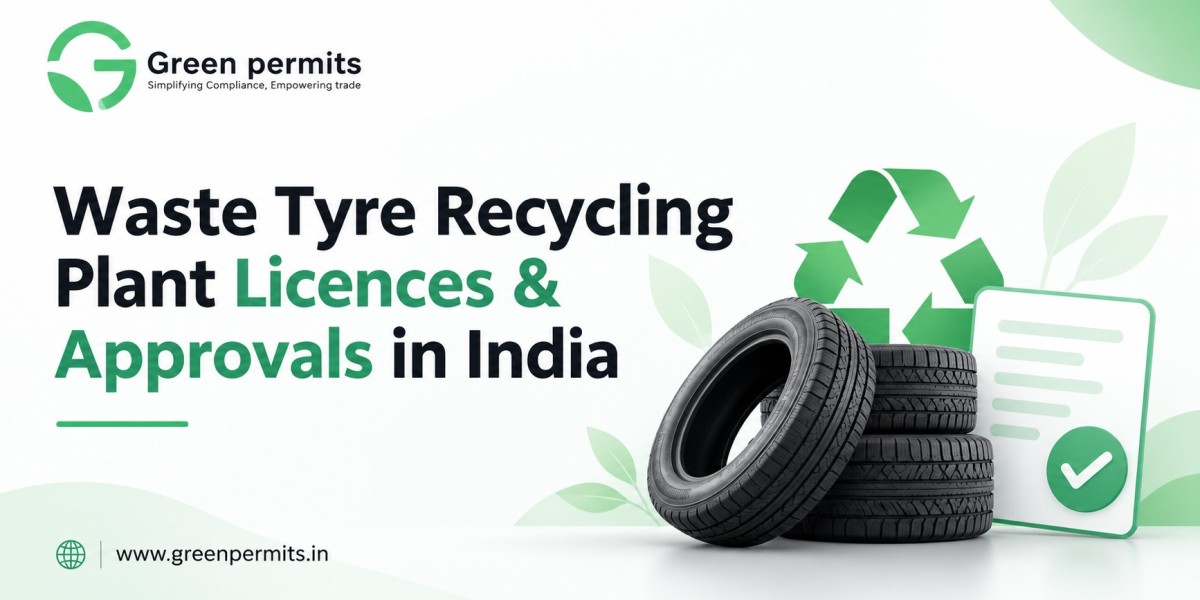

Setting up a Waste Tyre Recycling Plant in India requires much more than purchasing shredders, crumb-rubber machinery or pyrolysis equipment. Waste tyres are covered under India’s waste-management framework, and recyclers need to plan pollution-control permissions, CPCB registration, land suitability, fire safety and other industrial approvals before commercial operations begin.
The compliance route also depends on what the plant actually intends to produce. A mechanical recycling facility manufacturing crumb rubber has a different process and environmental profile from a reclaimed-rubber unit or a tyre-pyrolysis facility. Investors should therefore freeze the feedstock, process, capacity and end products before preparing the approval strategy.
India’s waste-tyre EPR framework was introduced through amendments to the Hazardous and Other Wastes rules. Producers, waste-tyre recyclers and retreaders covered by the framework are required to register through the prescribed system, and registered recyclers form part of the EPR certificate mechanism. Central Pollution Control Board
Green Permits Consulting supports investors with Waste Tyre Recycling Plant feasibility studies, DPR preparation, licence mapping, CTE/CTO support, CPCB registration, machinery planning and complete project implementation assistance.
Decide the Waste Tyre Recycling Process First
The first step is to clearly identify what the plant will do with waste tyres.
A mechanical recycling facility may process tyres into crumb rubber, rubber granules, rubber powder, steel and fibre. A reclaimed-rubber project carries out additional processing to produce reusable rubber material. A pyrolysis project uses thermal treatment and produces different outputs and therefore requires a different pollution-control and safety assessment.
For a mechanical plant, the process may broadly follow:
Waste Tyre → De-beading → Cutting / Shredding → Granulation → Steel Separation → Fibre Separation → Crumb Rubber
The regulatory application, pollution-control systems and plant layout should reflect the actual process. It is better to establish this at DPR stage rather than purchasing machinery first and attempting to modify the approval application later.
Land and Industrial Site Approval
Before applying for major plant permissions, investors should confirm that the proposed land can legally be used for the recycling activity.
An established industrial area is often easier to evaluate because industrial land use, road access, power and surrounding industries are already present. Standalone or agricultural land may require additional land-use or development permissions depending on the state and local authority.
Site selection should consider not only land price but also waste tyre availability, finished-product buyers and environmental suitability. Waste tyres require considerable storage space, and loose tyres have poor transport efficiency, so long collection distances can increase operating cost.
A practical location study should therefore examine:
Waste Tyre Source → Plant Location → Finished Product Buyer
This helps combine regulatory suitability with project economics.
Consent to Establish - CTE
For applicable recycling projects, Consent to Establish - CTE from the State Pollution Control Board or Pollution Control Committee is generally one of the key permissions to address before establishing the plant.
The CTE application usually describes the proposed capacity, manufacturing process, machinery, raw materials, products, water requirement, emissions, waste generation and pollution-control systems. Requirements and industry categorisation can differ by state and plant process.
For a tyre recycling project, the authority may examine issues such as dust generation, rubber handling, noise, wastewater if any, storage areas and management of rejects.
The plant layout and technical process submitted during CTE should therefore match the machinery that will eventually be installed.
Consent to Operate - CTO
After construction and machinery installation, the plant generally needs to address Consent to Operate - CTO requirements before regular commercial production, where applicable.
The Pollution Control Board may verify whether the plant has been established in accordance with the approved process and whether required pollution-control equipment has been installed.
The basic compliance sequence is usually:
Site Finalisation → CTE → Construction & Machinery → Pollution Controls → CTO → Commercial Operations
Investors should avoid treating CTE and CTO as the same approval. CTE deals with establishing the proposed facility, while CTO relates to operating the installed facility under the applicable consent conditions.
CPCB Waste Tyre Recycler Registration
Waste-tyre recyclers covered under the EPR framework need to consider registration on the prescribed waste-tyre portal.
The 2022 waste-tyre provisions state that producers, recyclers and retreaders covered by the Schedule must register on the portal and that covered entities should not carry out the regulated business without registration. Central Pollution Control Board
CPCB’s guidance also explains that registered recyclers report quantities of waste tyres procured, recycled and converted into end products through the EPR system. The portal uses the reported recycling and product information for generation of eligible EPR certificates or credits. Central Pollution Control Board
For investors, this means CPCB registration should be treated as a core part of project implementation rather than something to be considered only after production begins.
EPR Certificate Framework for Waste Tyre Recyclers
Waste tyre EPR creates an additional compliance-linked market around formal recycling.
Under the framework, producers meet applicable EPR obligations through certificates from registered recyclers. The rules provide for EPR certificates to be generated through the portal based on eligible recycling outputs and the prescribed calculation mechanism. Central Pollution Control Board
However, investors should not prepare a DPR assuming that every tonne of waste tyre automatically generates an equal tonne of certificate value or that certificate prices will remain fixed.
The core recycling business should first work through:
Waste Tyre Procurement → Recovery Yield → End Product Sales
EPR certificate revenue should be modelled separately and conservatively.
Hazardous Waste and Other Waste Compliance
The waste-tyre EPR framework operates within the Hazardous and Other Wastes (Management and Transboundary Movement) Rules. The exact authorisations and conditions applicable to an individual recycling plant will depend on the process, waste streams and residues generated.
A mechanical crumb-rubber facility can have a different compliance profile from a pyrolysis unit. Any additional hazardous wastes generated from maintenance, chemicals or other operations may also need to be evaluated separately.
The project should therefore conduct a process-specific regulatory review instead of assuming that one standard licence list applies to every tyre recycling plant.
Special Consideration for Tyre Pyrolysis Plants
Tyre pyrolysis requires greater environmental and safety planning because the process involves thermal conversion and may produce oil, recovered carbon material, steel and gaseous fractions.
Air pollution-control systems, process safety, storage and residue management need to be considered while designing the facility.
The waste-tyre rules also specifically prohibit the import of waste tyres for the purpose of producing pyrolysis oil or char. Central Pollution Control Board
Where pyrolysis oil or other combustible materials are stored, the project may also need to assess applicable fire, storage and petroleum-related requirements depending on the exact configuration and quantity.
Investors should therefore not apply the same licence checklist used for a mechanical crumb-rubber plant to a tyre-pyrolysis project.
Fire NOC and Safety Planning
Waste tyres and rubber products create a significant combustible load, so fire safety should be included in plant design from the beginning.
The site should provide adequate internal roads, emergency access, storage separation and suitable fire-fighting infrastructure. Fire NOC or related approval requirements will depend on the building, state regulations and local fire authority.
Storage is particularly important. Large uncontrolled tyre stacks can increase fire risk and make emergency response difficult.
The final layout should therefore provide separate areas for incoming tyres, processing machinery, finished products and rejects, with sufficient movement and safety access between them.
Factory and Local Industrial Approvals
Depending on the size, workforce, power load and state requirements, the project may also need factory-related registration or licensing, building-plan approval, electricity sanction and other local industrial permissions.
These approvals should be mapped during the DPR stage because they affect both project cost and implementation time.
For example, the electricity load required for high-capacity shredders, granulators and separation equipment can be substantial. The promoter should verify power availability before finalising the site.
Similarly, the factory layout should account for material movement, machinery clearances, storage and fire access before civil construction begins.
Documents Required for Approval Planning
The exact documents vary between states and applications, but a recycling project will generally need a clear set of company, land and technical documents.
Instead of preparing each application independently, the promoter should first create a master project document set containing company details, land documents, site layout, process flow, machinery list, proposed capacity, material balance, pollution-control plan and utility requirement.
These same technical assumptions should remain consistent across CTE, CTO, CPCB registration and related applications.
Differences in plant capacity, end products or machinery between applications can create unnecessary clarification requirements.
Correct Approval Sequence for Waste Tyre Recycling Plant
A better project-development approach is to integrate approvals with technical planning rather than starting compliance after the machinery has arrived.
The recommended sequence is:
Feasibility Study → Feedstock Assessment → Site Selection → Process & Capacity → DPR → CTE → Civil & Machinery → CPCB / Applicable Registrations → CTO → Commercial Operations
Some activities can proceed in parallel depending on the project and regulatory procedure, but the overall objective should remain the same: the plant that is constructed should match the plant that was approved.
DPR for Waste Tyre Recycling Plant
A professional Waste Tyre Recycling Plant DPR should combine market, technical, regulatory and financial planning.
The DPR should evaluate waste tyre availability, collection radius, recycling technology, plant capacity, machinery, land, utilities, recovered products, CAPEX, OPEX and working capital. It should also identify the applicable approval pathway before construction begins.
Financial projections should consider revenue from products such as crumb rubber, steel and other applicable recovered outputs, while EPR-related revenue should be evaluated separately rather than treated as guaranteed income.
This gives investors a more realistic understanding of the project before committing capital.
How Green Permits Helps
Green Permits Consulting supports entrepreneurs, recyclers and industrial companies with Waste Tyre Recycling Plant feasibility studies, DPR preparation, CTE and CTO planning, CPCB waste-tyre recycler registration, environmental compliance, machinery assessment and project implementation support.
The objective is to align the recycling process, plant capacity, approvals and financial model before major investment begins.
Learn More About Waste Tyre Recycling Plant Setup
If you are planning a waste tyre recycling facility, the project should first evaluate feedstock, recycling technology, site, end-product market and applicable licences before machinery is finalised.
Read more about recycling plant setup and DPR consulting services here:
? https://www.greenpermits.in/09/waste-tyre-recycling-licences-cte-cto-checklist/
? Get Expert Assistance for Waste Tyre Recycling Plant Licences
If you are planning a Waste Tyre Recycling Plant in India, Green Permits Consulting can assist with licence mapping, DPR preparation, CTE/CTO, CPCB registration and complete project implementation.
? Website: www.greenpermits.in
? Phone: +91 78350 06182
? Email: wecare@greenpermits.in